Convert 1 metric ton to kilograms.
- Amount
- 1 metric ton
- Type
- Metric (t)
Inputs
- Kilograms
- 1,000 kg
- Formula
- 1 × 1,000
Result
The metric ton is the only one with a round factor — exactly 1,000 kg.
See exactly what any ton figure is in kilograms — live, as you type.
Direction
Ton type
1 t equals 1,000 kg, using the exact factor of 1,000 kg.
Overview
A ton to kg calculator converts a weight given in tons into kilograms — instantly, and in whichever of the three ton definitions you actually mean. You type a number, pick the ton type, and it multiplies by the exact conversion constant. The word 'ton' is ambiguous: it can mean a metric ton, a US short ton, or a UK long ton, and the three are not equal. This tool defaults to the metric ton (the global standard) and lets you switch with one tap.
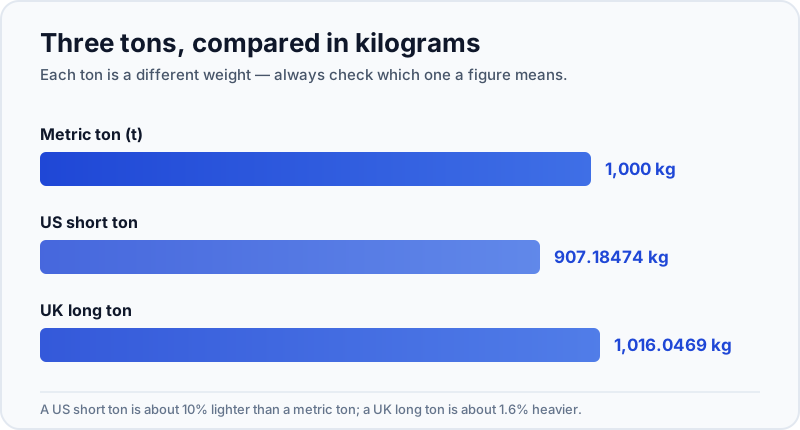
The three definitions matter. A metric ton (also spelled tonne, symbol t) is exactly 1,000 kg. A US short ton is 907.18474 kg — the 2,000-pound ton used across American freight and industry. A UK long ton is 1,016.0469 kg — the older 2,240-pound imperial ton. Using the wrong one on an invoice or a shipping manifest can shift a figure by roughly 10%, so the calculator always shows the exact constant it used.
This ton to kg converter is built for anyone who moves between the two units: logistics and import/export professionals reading manifests, students working through physics problems, farmers weighing crops, and builders costing steel or aggregate. Every figure is computed in your browser, so nothing you type is sent anywhere or stored.
Formulas and content last reviewed . Ton definitions are fixed by the SI — but always confirm which ton type a source means before you convert.
The short answer
To convert tons to kilograms, multiply the number of tons by the number of kilograms in one ton — but that constant depends on which ton you mean. For a metric ton, multiply by 1,000: 1 metric ton = 1,000 kg, so 10 tons = 10,000 kg. For a US short ton, multiply by 907.18474: 1 short ton = 907.18474 kg. For a UK long ton, multiply by 1,016.0469: 1 long ton = 1,016.0469 kg. Outside the United States, an unqualified 'ton' almost always means the metric ton, so 1 ton = 1,000 kg is the answer you usually want, and yes, 1,000 kg is exactly equal to 1 metric ton. To go the other way — kilograms to tons — divide instead of multiply. The calculator above does all three conversions live as you type and prints the exact constant beside the result so you can check it.
Benefits
Metric, US short and UK long tons — switch definitions with one tap instead of hunting for the right converter.
1,000 / 907.18474 / 1,016.0469 kg are printed next to every result, so you can verify the arithmetic yourself.
The maths runs as JavaScript on your device. No account, no server call, no record of anything you type.
No signup wall, no usage cap, no premium tier. Convert as many weights as you need, in either direction.
Guide
Type the weight you want to convert, or tap a quick-value chip. The result updates instantly — there is no submit button.
Choose Metric, US short or UK long. If you are unsure and outside the US, metric is the safe default.
Toggle Tons → Kg or Kg → Tons. The input unit and the result swap instantly.
The converted value appears with the exact conversion constant beside it, so you can trust and check the figure.
Examples
Inputs
Result
The metric ton is the only one with a round factor — exactly 1,000 kg.
Inputs
Result
A US ton is about 93 kg lighter than a metric tonne.
Inputs
Result
Multiplying metric tons by 1,000 just moves the decimal three places.
Formula & method
kg = tons × factor
Tons to kilograms — multiply by the exact constant for your ton type.
Decide which ton you mean — metric, US short, or UK long.
Take the exact constant: 1,000 / 907.18474 / 1,016.0469 kg respectively.
Multiply the number of tons by that constant to get kilograms.
To convert kilograms back to tons, divide by the same constant instead.
Methodology
1 metric ton = 1,000 kg exactly (SI definition).
1 US short ton = 907.18474 kg (2,000 lb × 0.45359237).
1 UK long ton = 1,016.0469 kg (2,240 lb × 0.45359237).
Results are pure unit conversions — no rounding beyond the decimals shown.
Conventions follow the SI (International System of Units), maintained by the BIPM, with US customary values published by NIST. Every result is derived from the exact kilogram-to-ton constants, so figures match the definitions rather than rounded approximations.
Primary sources
Details
Three tons exist: metric (1,000 kg), US short (907.18474 kg) and UK long (1,016.0469 kg).
Metric tons dominate international trade and science; the US uses short tons; long tons are historical/imperial.
Outside the United States, an unqualified 'ton' means a metric ton — so 1 ton = 1,000 kg.
Yes, 1,000 kg equals exactly 1 metric ton; that round relationship is unique to the metric system.
Because a 'ton' price means different quantities in different countries, cross-border contracts should name the ton type.
How it connects
Applications
Read manifests and freight quotes correctly by converting between the metric and short tons used on either side of a shipment.
Convert crop, feed and livestock weights between kilograms and tonnes for yield reporting and sales.
Move between kilograms and tons for steel, concrete and aggregate quantities without a rounding mistake.
Answer 'how many kg in a ton' for homework, recipes scaled up, or plain curiosity — with the exact factor shown.
Related tools
FAQs
Multiply the tons by the kilograms in one ton. For a metric ton that constant is 1,000, so 5 metric tons = 5,000 kg. For a US short ton it is 907.18474 kg, and for a UK long ton it is 1,016.0469 kg.
Security & privacy
Uses the exact kilogram-to-ton constants defined by the SI and published by NIST.
No signup, no email wall, no paywall. Every calculator is fully usable on first visit.
Every calculation runs client-side in JavaScript. Nothing is sent to a server or stored.
Served over HTTPS with no mixed content. Read our privacy policy or see the formulas and methodology behind every figure.
A headline 'ton' figure tells you almost nothing on its own, because three ton types exist. Enter your figure and pick the ton type to see the exact weight in kilograms — then use the right constant on every document.